Roughstalk bluegrass is a cool-season perennial grass. It grows in turf and disturbed moist areas in the Sierra Nevada foothills, San Francisco Bay region, northwestern South Coast Ranges, western North Coast Ranges, North Coast, and likely elsewhere in California to about 3300 feet (1000 m). It is one of the three members in the genus Poa commonly found in turfgrass sites in California. The other two are Kentucky bluegrass, Poa pratensis, and annual bluegrass, Poa annua. Roughstalked bluegrass, P. trivialis, is a less desirable turf species that does well in moist, shaded areas but lacks heat and drought tolerance and is generally considered a weed.
Habitat
Roughstalk bluegrass is found in alfalfa, turf and disturbed, moist areas.

Mature Plant
Roughstalk bluegrass grows upright to 3-1/3 feet (1 m) tall from a dense tuft of short stolons (aboveground creeping stems) at the base. Stems are slightly compressed and leaves are rolled in the bud. Flowers cluster to form an inflorescence and are arranged along open branches (panicle).
Roughstalk bluegrass can be confused with Kentucky bluegrass, which is sometimes used in golf course greens, and fowl bluegrass, Poa palustris. All three grasses have cobwebby hairs at the base of the florets (individual tiny flowers). However, the sheath of roughstalk bluegrass is open 3/4 of its length, while Kentucky bluegrass sheaths are open 1/2 to 3/4 and fowl bluegrass sheaths are open more than 3/4 of their total lengths. Roughstalk bluegrass is also distinctively rougher than those of the other two species.

Collar Region
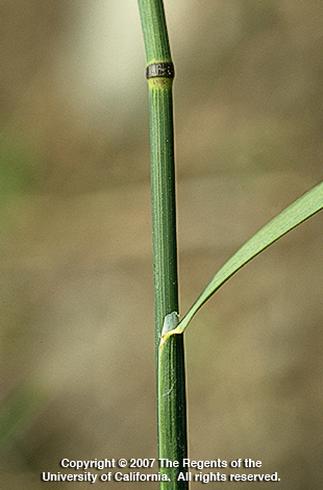
The collar is wide, distinctive, hairless, and separated at the midrib. The long, pointed ligule is membranous while that of Kentucky bluegrass is short, even, and membranous.
Flowers
Flowers bloom from February through March. The flower clusters (inflorescence) are found along flowering stem branches (panicle) like that of other turf bluegrasses. The overall the inflorescence form is lance to egg-shaped and about 3-1/5 to 10 inches (8–25 cm) with open branches that are spreading to ascending (rise at a slant). Like Kentucky bluegrass and fowl bluegrass, florets have a tuft of cobwebby hairs.

Reproduction
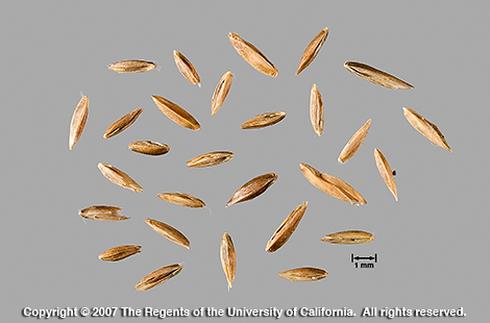
Roughstalk bluegrass spreads by aboveground creeping stems (stolons) and seeds.
Related or Similar Plants
- Annual bluegrass, Poa annua
- Canada bluegrass, Poa compressa
- Fowl bluegrass, Poa palustris
- Kentucky bluegrass, Poa pratensis