In Brief
- Invasive shothole borers are tiny beetles that bore into trees and infect them with a fungal disease.
- Many common landscape trees like maples, California sycamore, and Valley oak can be killed by this beetle-fungus complex.
- The main sign of infection is the beetle's exit and entrance holes in the tree's trunk and branches.
- Maintain tree health with proper care and monitor for signs of the beetles.
Pest Notes: Introduction
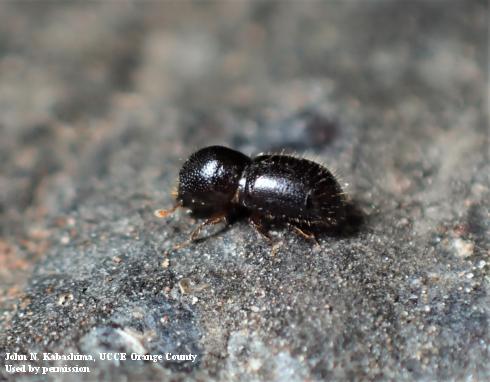
Invasive shothole borers (ISHB) are non-native beetles that belong to a group known as ambrosia beetles that “farm” certain fungi for food. The tiny adult beetles bore into trees and introduce a fungus that causes the tree disease known as Fusarium dieback (FD). This insect-pathogen complex has been responsible for the death of tens of thousands of urban and riparian trees in Southern California.
The two ISHB species currently found in California are the polyphagous shothole borer (Euwallacea fornicatus) and the Kuroshio shothole borer (Euwallacea kuroshio). Visually, these two species are identical and require DNA analysis to distinguish them. Each beetle species is associated with specific symbiotic plant pathogenic fungi, which can also be used to confirm beetle species. Fusarium euwallaceae is associated with polyphagous shothole borer and F. kuroshium is associated with Kuroshio shothole borer.
Over 78 species of trees and shrubs have been identified worldwide as ISHB-FD reproductive hosts (trees in which the fungus can grow, and the beetles can reproduce), including many California native and common landscape tree species. Another 247 species in 64 plant families are attacked but the beetles cannot successfully reproduce in them. Among the confirmed reproductive hosts, the combined effects of the beetles and the fungal pathogens have different impacts. On some, they cause tree decline and branch dieback, while on others they cause tree death (Table 1). In some cases, hosts only get infested with ISHB-FD in the margins of preexisting canker infections caused by other wood canker fungal pathogens. Visit UC ANR's Invasive Shothole Borers website to find the updated list of ISHB-FD reproductive hosts.
By early 2023, invasive shothole borers were present in 7 counties in Southern California: Los Angeles, Orange, Riverside, San Bernardino, San Diego, Santa Barbara, and Ventura. One of the beetle species, polyphagous shothole borer, has also been detected in other countries, including Mexico, Israel, South Africa, Australia, and Taiwan. A current map showing the distribution of ISHB in California can be found at the Invasive Shothole Borers website . Because of the wide host range, if left unmanaged, ISHB can potentially spread to the rest of California and neighboring states. Epidemiological forecasting of ISHB-FD based on microclimate and host distribution data in urban forests has predicted many locations throughout California where the pest-pathogen complex could establish, including Sacramento and the San Francisco Bay Area.
| Common name | Latin name | Host plant native to CA? |
|---|---|---|
| American sweet gum | Liquidambar styraciflua | No |
| Arroyo willow | Salix lasiolepis | Yes |
| Big leaf maple | Acer macrophyllum | Yes |
| Black cottonwood | Populus trichocarpa | Yes |
| Black poplar | Populus nigra | Yes |
| Black willow | Salix gooddingii | Yes |
| Box elder | Acer negundo | Yes |
| California sycamore | Platanus racemosa | Yes |
| Castorbean | Ricinus communis | No |
| English oak | Quercus robur | No |
| Fremont cottonwood | Populus fremontii | Yes |
| Japanese maple | Acer palmatum | No |
| London plane | Platanus x acerifolia | No |
| Palo verde | Parkinsonia aculeata | No |
| Red willow | Salix laevigata | Yes |
| Trident maple | Acer buergerianum | No |
| Valley oak | Quercus lobata | Yes |
| Common name | Latin name | Host plant native to CA? |
|---|---|---|
| Acacia | Acacia spp. | No |
| African tulip tree | Spathodea campanulata | No |
| Australian blackwood | Acacia melanoxylon | No |
| Australian pine tree | Casuarina equisetifolia | No |
| Avocado | Persea americana | No |
| Black mission fig | Ficus carica | No |
| Black wattle* | Acacia mearnsii | No |
| Blue palo verde | Cercidium floridum | Yes |
| Brazilian coral tree | Erythrina falcata | No |
| Bur oak | Quercus macrocarpa | No |
| California buckeye | Aesculus californica | Yes |
| Camellia | Camellia semiserrata | No |
| Canyon live oak | Quercus chrysolepis | Yes |
| Cape silver willow* | Salix mucronate | No |
| Carrotwood | Cupaniopsis anacardioides | No |
| Chinese flame tree | Koelreuteria bipinnata | No |
| Chinese holly | Ilex cornuta | No |
| Chinese wingnut | Pterocarya stenoptera | No |
| Coast coral tree | Erythrina caffra | No |
| Coast live oak | Quercus agrifolia | Yes |
| Coral tree | Erythrina coralloides | No |
| Cork oak | Quercus suber | No |
| Council tree | Ficus altissima | No |
| Coyote bush | Baccharis pilularis | No |
| Dense logwood / Shiny xylosma | Xylosma congesta | No |
| Engelmann oak | Quercus engelmannii | Yes |
| Evergreen maple | Acer paxii | No |
| Forest bushwillow* | Combertum kraussii | No |
| Fountain bush* | Psoralea pinnata | No |
| Honey locust | Gleditsia triacanthos | No |
| Jacaranda | Jacaranda mimosifolia | No |
| Japanese beech | Fagus crenata | No |
| Japanese wisteria | Wisteria floribunda | No |
| Kentia palm | Howea forsteriana | No |
| Keurtije* | Podalyria calyptrata | No |
| King palm | Archontophoenix cunninghamiana | No |
| Kurrajong | Brachychiton populneus | No |
| Laurel leaf snailseed tree | Cocculus laurifolius | No |
| Mesquite | Prosopis articulata | Yes |
| Mexican sycamore | Platanus mexicana | No |
| Mimosa | Albizia julibrissin | No |
| Moreton Bay chestnut | Castanospermum australe | No |
| Mule fat | Baccharis salicina | Yes |
| Purple orchid tree | Bauhinia variegata | No |
| Quaking aspen | Populus tremuloides | No |
| Red flowering gum | Corymbia ficifolia | No |
| Silver leaf maple | Acer saccharinum | No |
| Solitaire palm | Ptychosperma elegans | No |
| Sonoran palo verde | Cercidium x sonorae | No |
| Southern magnolia | Magnolia grandiflora | No |
| Strawberry tree | Dombeya cacuminum | No |
| Sweet bay | Magnolia virginiana | No |
| Tamarisk | Tamarix ramosissima | No |
| Titoki | Alectryon excelsus | No |
| Tree of heaven | Ailanthus altissima | No |
| Tree-In-A-Hurry* | Virgilia oroboides | No |
| Tulip wood | Harpullia pendula | No |
| Weeping willow | Salix babylonica | No |
| White alder | Alnus rhombifolia | Yes |
| White willow* | Salix alba | No |
* only found infested with ISHB-FD in South Africa
Identification and Biology
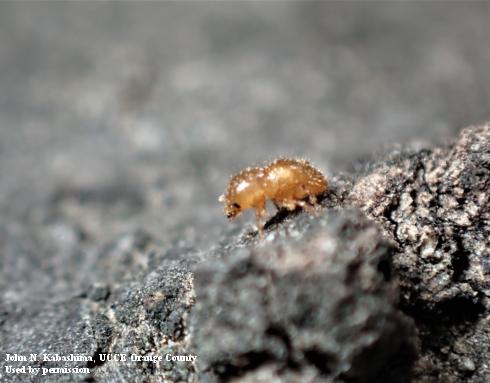
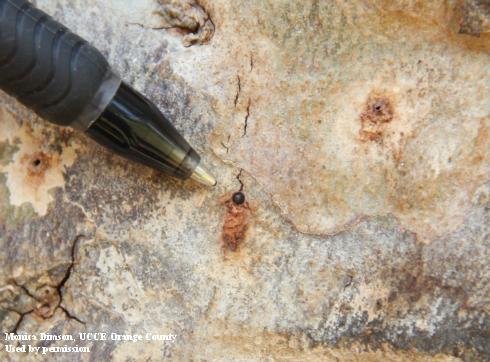
Female adult beetles are 1/16 to 1/10 inch (1.8–2.5 mm) in length and range from brown to black in color. Males are smaller (1/16 inch (1.5 mm) in length), light brown to black in color, and flightless. Since invasive shothole borers spend most of their life inside the host plant, infestation assessment relies on correct identification of signs and symptoms on the infested plant. The main sign of ISHB-FD infestation is the presence of the gallery entrance/exit holes in the trunk, branches, or both. The holes are small (1/32 inch or 0.85mm in diameter) and perfectly round, roughly the size of the tip of a medium ball point pen. Removing the first layer of bark should reveal a hole surrounded by discolored tissue caused by the fungal infection.
The entrance and exit holes are often accompanied by other signs and symptoms. These can include wet staining around the holes, frass (solid insect waste product) and boring dust (resembles fine saw dust), gumming, and sometimes sugary buildup (common in avocado trees). Since every host plant species responds differently to ISHB-FD, the combination of signs and symptoms observed might vary; however, entry holes are always present in infested plants. Branch dieback is often a symptom of an advanced ISHB-FD infestation.
Many other pests and diseases cause similar symptoms to ISHB-FD and can appear on the same plant species, so proper pest identification is critical. In addition, there are several species of ambrosia beetles and bark beetles that are native to California and could easily be confused with ISHB. Unlike ISHB, which colonizes mostly healthy trees, most of these lookalike species attack only stressed, injured, or dying trees. The easiest way to distinguish ISHB-FD symptoms from the ones caused by other pests and diseases is the presence of an entry hole that is the right size and shape.
Invasive shothole borer females bore into trees creating a series of galleries or tunnels where they lay their eggs and grow their symbiotic fungi. Female beetles carry the fungal spores with them within specialized structures located at the base of their mouthparts. ISHB beetles do not eat wood; instead, both larvae and adults rely on their symbiotic fungi as their sole source of food. Their larvae are white, C-shaped, and legless, with an orange head capsule. Invasive shothole borers have 3 larval instars before pupating and becoming adults. Pupae are white, the same size as adult beetles. It takes 25–50 days for the larvae to grow into pupae and become adults under ideal temperature conditions. Models based on the effect of temperature in their development suggest that ISHBs can have 5–11 generations per year in southern California.
ISHB females can lay up to 57 eggs, of which most are fertilized (which will become female offspring) and only a few are unfertilized (which will become male offspring). Once they mature, ISHB siblings mate with each other inside their gallery, then the female offspring are ready to disperse. Although dispersing females are usually mated, an unmated female can start a population by laying unfertilized eggs (which would become male offspring) and then mating with her male offspring.
Only female beetles can fly and infest other trees; males do not fly. Females only fly when air temperature is higher than 68°F. Most females make their own galleries in the same tree where they were born, which is why ISHB infestations are generally found concentrated in a few trees during early infestation stages. As the beetle population grows within these severely infested trees and the tree declines, the beetles start to rapidly infest neighboring trees.
Management
It is unlikely that ISHB will be eradicated from the areas where it is already established. However, there is evidence that by consistently following an appropriate management plan, ISHB infestations can be contained, minimizing their impact. A successful management plan for ISHB-FD should include regular monitoring of tree health and quickly identifying sources of beetles (such as heavily infested branches or trees). The plan should also include cultural practices to maintain tree health, guidelines for removing severely infested trees and branches, specifications for disposing of cut infested wood, and parameters for when the use of pesticide treatments may be appropriate. The recommended actions vary depending on the tree species, location, infestation level, hazard level, and tree value. If ISHB attack is confined to the branches of host tree, prune affected branches immediately to prevent advancement to the trunk. Prune hazardous branches on high-value hosts and treat pruning wounds to prevent re-infestations. Table 2 summarizes possible actions for infested trees located in and around urban areas. Below are some definitions used in the table. Keep in mind though that definitions for tree value and hazard level vary. Classification must be determined by site and site use (e.g., economic or cultural value and risk to people or property).
- Reproductive Host: Plant species suitable for beetle reproduction and growth of Fusarium euwallaceae or F. kuroshium.
- Non-Reproductive Host: Plant species that have not yet proved suitable for beetle reproduction; however, these species might be susceptible to Fusarium euwallaceae or F. kuroshium.
- High Hazard Level: Trees that might pose a high risk to people or property (e.g., trees adjacent to walkways, playgrounds, high-use lawns, parking lots).
- Low Hazard Level: Trees that pose a low risk to people or property.
Table 2a: ISHB-FD management matrix for infested urban and peri-urban forest. ISHB infestation level and management options for low value trees (species of low economic value; smaller and/or younger trees; trees with undesirable form, structural issues (e.g., codominant branches), or other issues (e.g., other pests)).
| Host Type | Hazard Level | No Infestation | Low (< 50 entry holes) |
Moderate (= 50 and < 150 entry holes} |
Heavy (= 150 entry holes) |
Severe (= 150 entry holes + ISHB-related dieback) |
|---|---|---|---|---|---|---|
| Reproductive Host | Low | Monitor | Monitor | Monitor & remove infested branches | Monitor & remove infested branches | Remove tree & stump |
| Reproductive Host | High | Monitor | Monitor & remove hazard branches | Monitor & remove infested/hazard branches | Remove infested/hazard branches, or remove tree & stump | Remove tree & stump |
| Non- Reproductive Host | Low | Monitor | Monitor | Notify your local UCCE office; consult with ISHB-FD experts to determine if species is a new reproductive host | Notify your local UCCE office; consult with ISHB-FD experts to determine if species is a new reproductive host | Notify your local UCCE office; consult with ISHB-FD experts to determine if species is a new reproductive host |
| Non- Reproductive Host | High | Monitor | Monitor | Notify your local UCCE office; consult with ISHB-FD experts to determine if species is a new reproductive host | Notify your local UCCE office; consult with ISHB-FD experts to determine if species is a new reproductive host | Notify your local UCCE office; consult with ISHB-FD experts to determine if species is a new reproductive host |
Table 2b. ISHB-FD management matrix for infested urban and peri-urban forest. ISHB infestation level and management options for high value trees (species of high economic or cultural value (e.g., heritage trees); larger and/or older trees).
| Host Type | Hazard Level | No Infestation | Low (< 50 entry holes) |
Moderate (= 50 and < 150 entry holes) |
Heavy (= 150 entry holes) |
Severe (= 150 entry holes + ISHB-related dieback) |
|---|---|---|---|---|---|---|
| Reproductive Host | Low | Monitor | Treat and/or remove infested branches | Treat and/or remove infested branches | Treat and/or remove infested branches | Remove tree & stump |
| Reproductive Host | High | Monitor | Treat and/or remove infested/hazard branches | Treat and/or remove infested/hazard branches | Remove infested branches, or tree & stump | Remove tree & stump |
| Non- Reproductive Host | Low | Monitor | Monitor | Notify your local UCCE office; consult with ISHB-FD experts to determine if species is a new reproductive host | Notify your local UCCE office; consult with ISHB-FD experts to determine if species is a new reproductive host | Notify your local UCCE office; consult with ISHB-FD experts to determine if species is a new reproductive host |
| Non- Reproductive Host | High | Monitor | Monitor | Notify your local UCCE office; consult with ISHB-FD experts to determine if species is a new reproductive host | Notify your local UCCE office; consult with ISHB-FD experts to determine if species is a new reproductive host | Notify your local UCCE office; consult with ISHB-FD experts to determine if species is a new reproductive host |
Monitoring
Early detection is the key to controlling this insect. Because no effective preventative treatments have been reported so far, regular monitoring is recommended to ensure infestations are managed early before they cause dieback or death and when the trees have the best chance of recovery. Frequent visual inspection of the trees is the best monitoring approach. Look for signs and symptoms of ISHB-FD infestation on both the trunk and branches.
Infestation level within a given tree is determined by the number of active galleries (entry holes) in the trunk and branches, and the presence of dieback associated to those beetle attacks (Table 2). Only active entry holes with live beetles inside the associated gallery should be considered to determine infestation levels. It is important to note that the entry holes may remain visible on the trunk and branches even after the beetles left or died. The presence of beetles, wet staining, and frass are good indicators that the entry holes are active. One other way to confirm if there are live beetles within the galleries is painting over selected entry holes with water-based latex paint. If an ISHB female is alive within the gallery, it will re-open the entry hole during the next 24 hours, proving that the entry hole is active.
Trapping can provide information about the presence of ISHB in an area. Both Lindgren funnel traps and sticky panel traps have been effective at detecting ISHB. When using a funnel trap, use soapy water or propylene glycol (sold as non-toxic antifreeze fluid) in the collection cup. Avoid using ethanol or ethylene glycol (standard antifreeze fluid) because these may diminish the effectiveness of the traps for ISHB and tend to attract many other lookalike beetles. Both funnel and sticky panel traps should be equipped with a quercivorol lure (sold separately) to help attract ISHB beetles. Lures should be replaced every 2 months or according to package instructions. Both traps and lures can be purchased from manufacturers and specialty retailers.
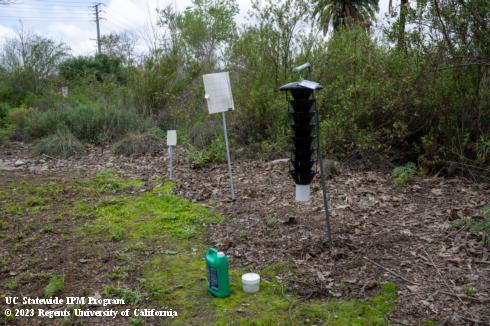
Place traps where ISHB host species are available, but avoid hanging the traps in or under the canopy. Do not hang the traps directly from tree branches; use a pole to hang or attach the trap instead. Placing sticky traps at a height of 2.5 feet from the ground increases the number of beetles caught, although traps might need to be installed slightly higher in windy and exposed areas to avoid getting the trap covered in dust and debris. Traps may be placed at 25– to 35–yard intervals throughout the monitored area. A higher concentration of traps is not advised.
Because the lures used for trapping ISHB are relatively weak, trapping is not an effective control method and is only used as a monitoring tool. For the same reason, each trap will only attract the beetles that are already present in the area, so the risk of attracting new beetles to the area by using quercivorol-baited traps is very low.
Mechanical control
Most trees that are severely infested (with more than 150 active entry holes and ISHB-related branch dieback) are not likely to recover from the infestation and will become a persistent source of beetles that can disperse and infest neighboring trees. Weakened branches on such trees are hazardous to people and property. Prompt removal of severely infested trees is recommended. Since ISHB can survive and reproduce on stumps for years, it is also recommended to either grind the stump or cut it to ground level after tree removal.
When infestations are concentrated on the branches (as commonly found in coast live oak and avocado), removing those branches is an effective control method. Pruning tools should be disinfected between trees to avoid spreading the fungus and other opportunistic pathogens. Effective disinfecting agents include a 70% solution of ethanol, a 5% solution of bleach, or commercial disinfectant solutions like Lysol. Infested plant material from pruning or removals should be disposed of properly to avoid spreading this pest.
Invasive shot hole borers can survive in cut wood for weeks or even months. It is vital to properly manage green waste to avoid spreading this pest to new areas. Do not move infested branches or logs offsite until they have been properly sanitized. Options for sanitation of infested wood include the following.
Chipping: Research has shown that the most effective practice is to chip infested wood as small as possible. The preferred chip size is 1 inch or smaller, which will kill 99.9% of the beetles. Chips that are 3 inches or smaller will kill 98% of the beetles. To eliminate the beetles from the wood, chipping should be followed by other sanitation methods like composting or solarizing. If the area is already infested, chips can be used as mulch for the surrounding trees. Chips that haven’t been composted or solarized should not be used as mulch in a different location.
Composting: After chipping the wood, composting—when done correctly—will kill the remaining beetles and fungi in the chips. Wood chips can be composted at a professional composting facility. Composting of small amounts of green waste (such as from pruning few branches) can be done at home, so long as guidelines are carefully followed to ensure the composting pile reaches the required temperature. These guidelines can be found at the UC IPM guidelines for composting. Composted, chipped plant material may then be re-purposed as mulch and safely moved to uninfested areas.
Solarizing: Infested chips and logs can be solarized under a clear tarp. When done correctly, solar energy will heat green waste until beetles and fungi are killed. The chips or logs should be wrapped with a clear, sturdy (at least 6 mil), UV-resistant plastic tarp. Do not use opaque tarps. The infested plant material should be fully contained by wrapping plastic both underneath and over the material. Seal the edges of the tarp by covering them with soil. Any holes that develop must be completely sealed. Keep log or chip layers as thin as possible, 2 logs deep maximum, to ensure even heating throughout the pile. To ensure high temperatures are achieved for long enough, infested material should remain covered for at least 6 weeks during July to August and at least 6 months during September to June.
Cultural control
Prevention is the best way to manage pest infestations. Limiting the movement of infested wood material is the best way to prevent the introduction of ISHB and other wood boring pests into new areas. Use locally sourced firewood (See the Buy It Where You Burn It website for more information) or use kiln-dried firewood. When acquiring wood chips (such as when using as mulch), make sure they come from a clean source.
Healthy, well-cared for trees are less likely to succumb to pest infestations. Proper cultural care, such as proper irrigation, maintaining good soil conditions, and protecting the tree from mechanical damage (for instance, damage by lawnmowing equipment) are key to a healthy and resilient tree. Removing any competing turf or other plants from the tree’s root zone and replacing that with a thin layer of mulch will help enhance the tree’s vigor.
When selecting trees for planting, consider the site conditions (such as water availability, soil type, temperature, maximum desired height and width of the tree) and choose a tree species that matches those requirements. Diverse tree communities are more resilient to pests. Avoid monocultures or high concentrations of a single (or just a few) tree species in an area. When replanting trees in heavily infested areas, make sure you first manage the current infestation and wait at least until you can ensure that the infestation is under control before planting highly susceptible hosts (species killed by ISHB; Table 1). ISHB host species can still be planted in infested areas as long as the infestation is proactively managed.
Biological control
There are no biological controls available for ISHB-FD, but several options are currently being researched. This includes the use of natural enemies (parasitic wasps from the areas where the beetles are native), nematodes, entomopathogenic fungi (fungi that attack insects), endophytes (microorganisms that live within the trees and can provide protection against Fusarium), and other beneficial microorganisms. These biological management options must be thoroughly tested before they become available.
Chemical control
Trees that are reproductive hosts for ISHB-FD and that show signs of active infestations (clusters of several entry holes associated with wet staining, frass, or both) can be treated with a combination of insecticides and fungicides. The decision to treat a particular tree depends among other things on the tree’s condition, value, and hazard level (Table 2). Trees that are not already infested should be monitored but not treated.
The pesticide products that reduced beetle attacks in research trials are available only to state-licensed and county-registered pesticide applicators. Consumer pesticide products are not concentrated enough to control ISHB-FD. Property owners and managers should consult with a certified arborist or pest control professional for appropriate pesticide treatment. Inappropriately applied pesticides can have negative impacts on the health of the tree, beneficial organisms (bees and natural enemies), and the environment.
Trunk sprays of the contact insecticide bifenthrin in combination with the fungicide Bacillus subtilis have been demonstrated to offer some control. The goal of the trunk sprays is to kill beetles that are about to disperse from the host or that landed on the tree looking for a new host. Hence, trunk sprays should be applied when the beetles are dispersing. ISHB typically has two annual dispersion peaks during the year, one in early spring (around February) and one in late fall (from September to November). However, flight and dispersion patterns vary by year and location. A local trapping program can help determine the best timing of application for each location and year.
Systemic pesticides can be applied to the soil or injected into the trunk. They are taken up through the tree, killing the insects and fungi inside the wood. Soil injections or drenching with the insecticide imidacloprid has been shown to reduce beetle attacks, as has trunk injection with the insecticide emamectin benzoate combined with the fungicide propiconazole. It is important to consider that trunk injections require drilling into the trunk. This produces a wound in the tree that could get infected with other pathogens. Therefore, it is usually only recommended for high-value, heavily infested trees or in situations in which other application methods are not possible or advisable. Systemic pesticides should be applied either in the spring or in the fall to ensure effective uptake and distribution of pesticides throughout the trunk. Watering the tree before and after the application might assist with the movement of the pesticides within the tree.
References
Cooperband M, Stouthamer R, Carrillo D, Eskalen A, Thibault T, Cosse A, Castrillo LA, Vandenberg JD, Rugman-Jones P. 2016. Biology of two members of the Euwallacea fornicatus species complex (Coleoptera: Curculionidae: Scolytinae), recently invasive in the USA, reared on an ambrosia beetle artificial diet. Agricultural and Forest Entomology 18: 233-237.
Eatough Jones M, Paine TD. 2015. Effect of chipping and solarization on emergence and boring activity of a recently introduced ambrosia beetle (Euwallacea sp., Coleoptera: Curculionidae: Scolytinae) in Southern California. Forest Entomology 108(4): 1852-1859.
Eatough Jones M, Kabashima J, Eskalen A, Dimson M, Mayorquin JS, Carrillo JD, Hanlon CC, Paine TD. 2017. Evaluations of insecticides and fungicides for reducing attack rates of a new invasive ambrosia beetle (Euwallacea Sp., Coleoptera: Curculionidae: Scolytinae) in infested landscape trees in California. Journal of Economic Entomology 110: 1611-1618.
Eskalen A, Stouthamer R, Lynch SC, Rugman-Jones PF, Twizeyimana M, Gonzalez A, Thibault T. 2013. Host Range of Fusarium Dieback and Its Ambrosia Beetle (Coleoptera: Scolytinae) Vector in Southern California. Plant Disease 97(7): 938-951.
University of California Agriculture and Natural Resources. 2023. Invasive Shothole Borers. Oakland, CA. www.ishb.org (Accessed 10 July 2023).
Lynch SC, Eskalen A, Gilbert GS. 2021 Host evolutionary relationships explain tree mortality caused by a generalist pest–pathogen complex. Evolutionary Applications 14:1083–1094.
Mayorquin JS, Carrillo JD, Twizeyimana M, Peacock BB, Sugino KY, Na F, Wang DH, Kabashima J, Eskalen A. 2018. Chemical management of invasive shot hole borer and Fusarium dieback in California sycamore (Platanus racemosa) in Southern California. Plant Disease 102: 1307-1315.
Umeda C, Eskalen A, Paine TD. 2016. Polyphagous Shot Hole Borer and Fusarium Dieback in California. Ch.26 in Insects and Diseases of Mediterranean Forest Systems. Editors: Paine TD, Lieutier F. Springer International Publishing. Switzerland.
Resources
- About Pest Notes
- Glossary
- Compare Risks from Pesticides Mentioned
- WARNING ON THE USE OF PESTICIDES
- List of other Pest Notes
Publication Information

Pest Notes: Invasive Shothole Borers
UC ANR Publication 74179
Author(s)
B.N.B. Nobua-Behrmann, UC Cooperative Extension, Orange County
A. Eskalen, UC Davis Plant Pathology
S.H. Hishinuma, USDA Forest Service
S.L. Lynch, State Univ. of New York-Environmental Science and Forestry
M.E.J. Eatough-Jones, UC Riverside Entomology
J.N. Kabashima (emeritus), UC Cooperative Extension, Orange and Los Angeles Counties
Technical Editor
K. Windbiel-Rojas, UC IPM
ANR Associate Editor
A.M. Sutherland, UC IPM and UC Cooperative Extension, San Francisco Bay Area
Editor
B. Messenger-Sikes, UC IPM