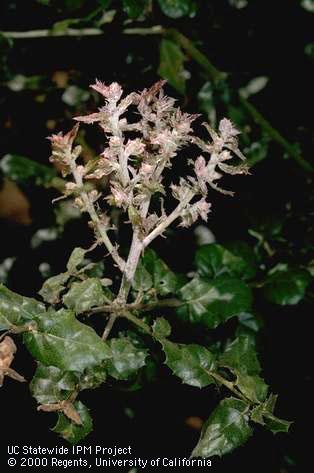
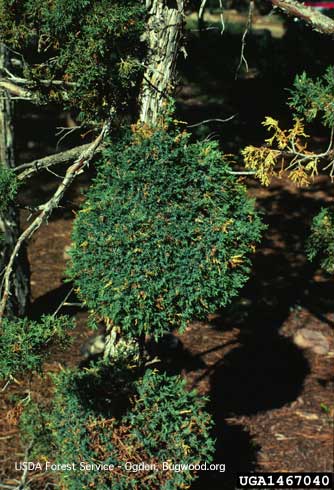
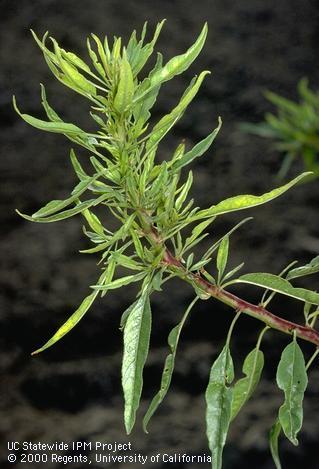
Witches' brooms typically are dense clusters of twigs or thickened stems that develop on the branches of woody plants. Affected leaves and shoots may become discolored, distorted, and dwarfed.
Identification
The specific appearance of witches' brooms varies with the particular cause and host plant(s). Causes and their hosts include
- cedar, cypress, and juniper rusts, Gymnosporangium species
- dwarf mistletoes, Arceuthobium spp. that infect conifers
- fasciation, which is caused by microorganisms and unidentified causes possibly including genetic factors; numerous plant species are uncommonly affected
- glyphosate herbicide injury and certain other herbicide phytotoxicities
- powdery mildew fungus of oaks, Cystotheca (=Sphaerotheca) lanestris
- rose rosette disease, a mite-vectored virus
- western gall rust, Endocronartium (=Peridermium) harknessii, a pine disease
- yellows, or phytoplasmas that mostly affect herbaceous plants
- zinc deficiency and possibly other nutritional disorders on most any woody species
Life cycle
The biology and development of witches' brooms varies with the particular situation. Oaks, for example, commonly develop witches' brooms after spring weather is cool and moist and in coastal areas where fog occurs during the growing season. The witches' brooms become apparent on oak terminals by late spring or early summer.
Rose rosette disease that causes witches' broom in roses is caused by an RNA virus in the genus Emaravirus. The virus is spread by a rose-feeding, wind-transported eriophyid mite, Phyllocoptes fructiphilus. This virus is common in the United States east of the Rocky Mountains but in California has only been reported in the Fresno area. Most rose viruses do not threaten plant survival; they only slow plant growth and mar the aesthetic appearance. Rose rosette virus, however, generally kills infected hosts.
Solutions
Provide plants with proper cultural care and a good growing environment to keep them vigorous. Where they are aesthetically objectionable, prune out witches' brooms at least several inches below where they form. This is commonly the only available management strategy, such as for most fasciations and western gall rust.
Removing affected roses and replanting using clean plants is the only management likely to be effective for rose rosette disease. Infected roses cannot be cured. Control of the eriophyid mite vector of this virus can reduce the risk of the pathogen spreading to uninfected roses. But good control of eriophyids using miticides is difficult to achieve in most gardens and landscapes. For more information see Five Ways to Manage Rose Rosette Disease and Rose Rosette Disease Demystified .
Adapted from the publications linked above and Pests of Landscape Trees and Shrubs: An Integrated Pest Management Guide, University of California Statewide Integrated Pest Management Program (UC IPM).