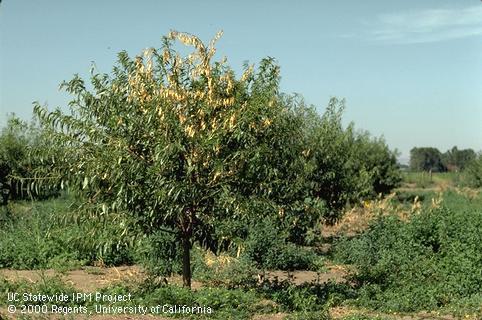
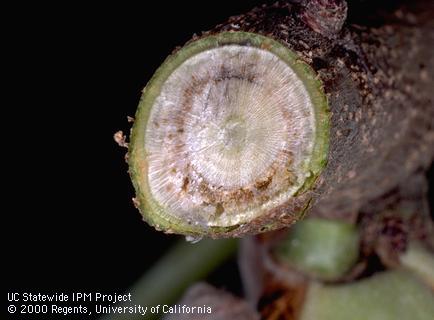
Verticillium wilt infections in almonds usually become apparent when leaves on one or more branches suddenly wilt, turn light tan, and die. Dead leaves generally remain on the tree throughout the growing season. Internally, the vascular tissue tissue turns dark, and cross sections of the branch will show a full or partial ring of discolored tissue.
Solutions
Verticillium wilt can be avoided in many cases by planting resistant or tolerant varieties or rootstocks. The Verticillium fungus has a wide host range, including tomatoes, cucurbits, caneberries, and stone fruit. Keeping these susceptible crops out of garden areas for 3to 5 years can reduce Verticillium to levels where a crop can be profitably grown for 1 or 2 years. Corn, other grains, carrots, lettuce, beans, and peas are some crops that could be used. Soil solarization during a summer fallow period before planting may help reduce disease levels. Proper fertilization and irrigation will help young trees recover from the fungus. Prune out all weakened and dead limbs in midsummer when the fungus is no longer active.