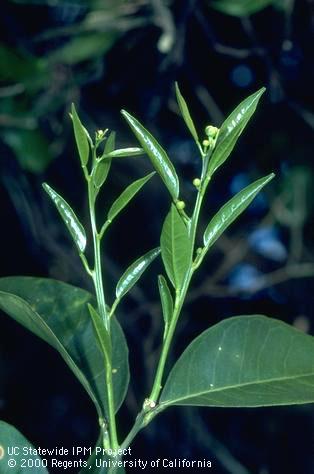
Young citrus will not require extensive pruning. They will, however, often produce very vigorous shoots that give the tree a wild appearance. These shoots may be pruned back a bit to give a more refined appearance. Be sure to prune off any suckers that arise below the graft or bud union.
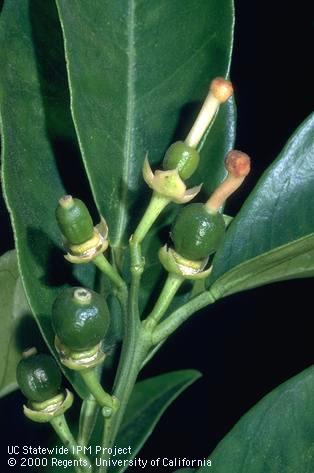
Fruit thinning is not usually required. After petal fall, the young fruit undergo rapid cell division. It is not uncommon for many small pea-sized fruit to drop about 1 month after bloom. Later in spring and early summer, larger golf ball-size fruit may drop if conditions that limit growth such as excess heat, lack of soil moisture, or adverse weather exist.
For a large fruiting area, citrus should be trained to be a full skirted tree with the foliage canopy extending almost to the soil line. Citrus can also be grown as a sheared hedge or informal espalier. Pruning is not required to keep citrus productive or attractive. You can, however, prune the branches up higher to make it easier to get under the tree. Try to keep the center somewhat open by removing crossing branches.
If you do prune, the ideal time is just prior to bloom or just after fruit set so that the tree can adjust its fruit load during the June drop. Minor pruning can be done at any time, but avoid late-season pruning, which can stimulate excessive tender growth that is likely to be injured by frost. Protect any exposed branches after pruning from sunburn by painting with a 50:50 white interior latex paint and water mixture.