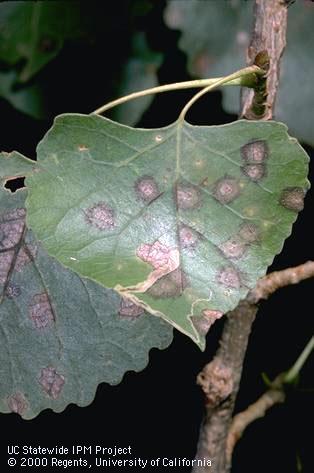
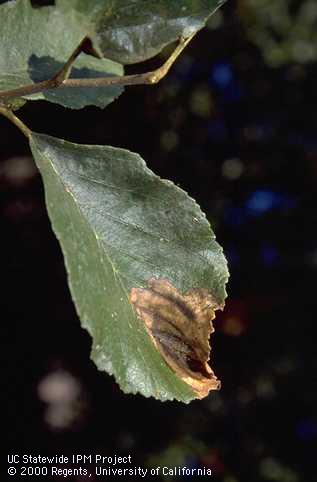
Several dozen Septoria spp. fungi each infect a different group of closely related hosts. Azalea, cottonwood, hebe, and poplar are commonly infected.
Infection by Septoria, which may be named Mycosphaerella during the conidial (asexual) stage, causes round or angular, flecked, sunken, or irregular spots on mostly older leaves. Black dots of spore-forming pycnidia may become visible within Septoria lesions. Populus spp. severely infected by Septoria populicola develop both leaf spots and branch cankers (Septoria canker).
Life cycle
The biology and management of Septoria is similar to that of anthracnose. The fungi overwinter primarily in cankers and lesions in infected twigs. Spores are produced when infected tissue is wet. Spores spread by splashing and windborne rain, germinate, and infect new twigs and foliage. Disease can be common when prolonged, cool, rainy weather occurs during new leaf growth.
Solutions
Where feasible, prune off infected wood in the fall after leaves drop from deciduous hosts and rake up and dispose of fallen leaves away from hosts. Reduce splashing water and humidity within canopies if possible.