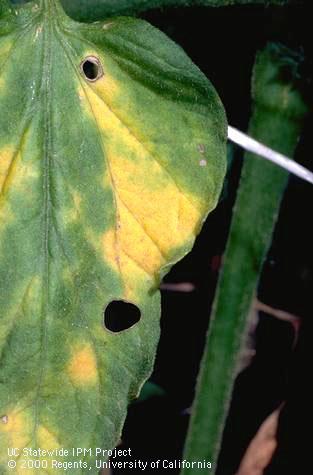
Plants infected with the Fusarium fungus turn yellow starting with one side or branch and gradually spreading through the plants, eventually killing them. Disease is caused by a fungus that infects tomatoes only. Disease is favored by warm soil.
Identification
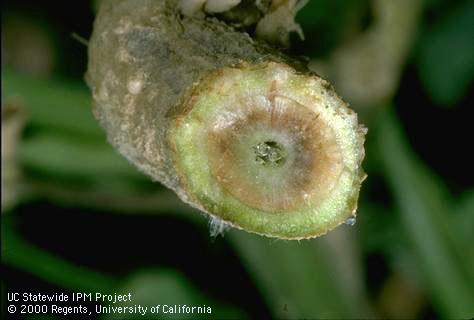
Both Fusarium and Verticillium wilt cause leaf yellowing and discoloration of the water-conducting tissues of the plant. Cut affected plants at the base of stems and examine them in cross section to see the browning of the water-conducting tissue compared to the healthy ivory of uninfected plants. Verticillium and Fusarium discoloration are extremely difficult to distinguish, although Fusarium discoloration tends to be darker. Fusarium tends to occur more in warmer soils and Verticillium in cooler ones. Management for both requires resistant varieties.
Life cycle
Both Fusarium and Verticillium form resistant structures that can survive in the soil in the absence of a living host. These soil fungi are spread in soil water, on equipment, transplants, or tubers. In the presence of a host plant, the resistant structures germinate and penetrate the plant's roots either directly or through wounds. Once inside the root, the fungus grows until it reaches the water-conducting cells, inside which it spreads upward through the plant, restricting water flow.
Solutions
Fusarium wilt of tomatoes can be avoided in many cases by planting resistant varieties which are indicated by the letters F or FF. If you wish to grow susceptible varieties, problems can sometimes be minimized by removing all residue, including roots, which may be susceptible, and using soil solarization before you plant.