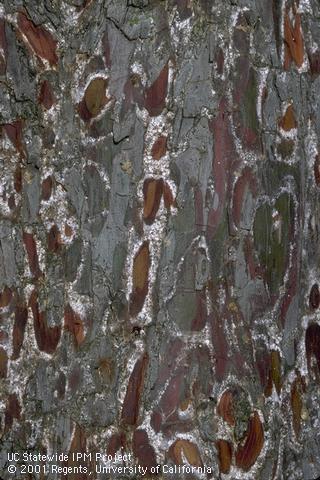
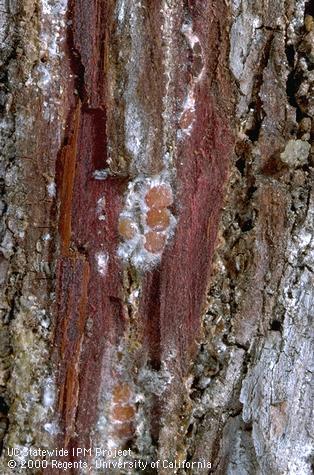
This sucking insect (Pseudococcidae) occurs beneath bark plates and in bark crevices on cedar, cypress, and juniper. Populations are usually innocuous in natural areas, but it can be a serious pest of Monterey cypress in urban areas.
Identification
Infestations are indicated by the mealybug's cottony wax protruding from bark cracks. The tiny, mobile first instars (crawlers) are yellowish. Cypress bark mealybug nymphs after settling and adult females are round, bright red or orangish, and surrounded by a ring of white wax. At maturity, the female is about 1/16 inch in diameter.
The adult male has a reddish-brown body, one pair of whitish, almost veinless wings, and a pair of long, white filaments at the rear. The male emerges from a small, white, saclike cocoon on bark.
Incense cedar scale, or Monterey cypress scale, Xylococculus macrocarpae, during its preadult female (cyst) stage closely resembles the cypress bark mealybug. Both species can occur on the same hosts and are easily overlooked on the rough, reddish bark.
Life cycle
Crawlers may be found from April through November. Except for adult males, the mealybugs do not move after the crawlers settle; they remain tightly in cracks of the bark. Cypress bark mealybug has one generation per year.
Damage
Foliage on infested plants becomes yellow and red and may die. Heavy populations cause dieback at the treetop, which gradually extends down the tree and may kill it.
Solutions
If the insects are abundant and damage cannot be tolerated, apply horticultural oil to the bark in August or September. For additional information, see mealybugs or the Pest Notes: Scales.