Site Selection
Avocados are adapted to a wide range of soils and should grow well where there is fairly good drainage. There should be no hardpan or rock layers within 3 feet of the soil surface. Lime deposits in the soil can cause poor growth and should be avoided. Soils that are poorly drained or where water remains standing for any length of time are also unsuitable and may lead to root rots.
Most avocados are adapted to warmer, tropical or subtropical climates. Depending upon the variety, avocado trees are generally damaged at low temperatures. The Guatemalan races of avocados are injured between 27° and 30° F, and the Mexican varieties can be injured between 24° and 26° F. Cold temperature sensitivity depends on many factors such as how long it stays cold, the weather prior to the cold, the position or exposure of your tree, and fruit maturity as well as variety.
Planting
The optimum time for planting containerized avocado trees is after the last frost in spring, giving the plant time to become established before the onset of hot weather.
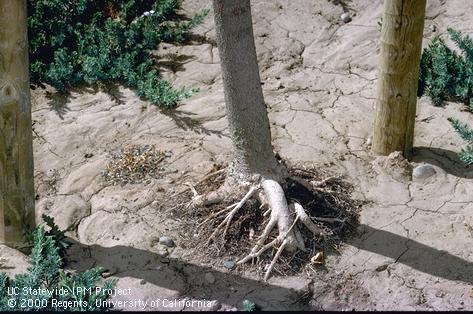
Trees should be planted at the same depth as they were in the container. If planted too deep, the soil or water tend to stand against the trunk which promotes root and crown rots such as Phytophthora rot or Avocado root rot. If planted too high, the roots will dry out too quickly.
Dig the planting hole so the root ball sits about 1 inch above the soil line. The width of the hole should be about twice the diameter of the root ball. Make sure the bottom of the planting hole is firm to avoid having the root ball sink. Cleanly remove broken or decayed roots. Backfill the planting hole with native soil and water in thoroughly after planting. Construct a watering basin that is about 1 foot away from the trunk of the tree. Keep the trunk dry as much as possible while irrigating.
If trunks are exposed to sun, it will also be important to protect them from sunburn by painting them with a 50:50 mix of white latex paint and water.
Watering
Watering correctly is critical to the development of good quality fruit and allows trees to preserve a natural resistance to fungal diseases. Underwatering produces fruit that is small, and fruit will tend to sunburn. Overwatering predisposes the tree to root and crown rots.
During the heat of summer, avocados will require about 2 inches of water per week for a mature tree. Citrus will require about 4 to 6 inches of water per month. However, depending upon your soil type, this amount may be divided up into several applications.
Ideally, in hot summer climate zones, you may want to irrigate about every 7 to 10 days during the middle of the summer. You may irrigate your trees using a drip system with either two to four emitters per tree or using small microspray emitters. Under a drip system, a tree may require 45 to 60 gallons per day in the heat of summer, depending upon the climate zone and soil characteristics. The root zone of avocado and citrus trees is shallow and drippers need to be placed at the base of the trunk on newly planted trees to keep the root ball moist until roots grow into the native soil. Apply water further from the tree trunk as trees become established.

Pruning
Young avocado trees should not require extensive pruning but do require early training. Whenever possible, allow trees to develop naturally. Be sure to prune off any suckers that arise below the graft or bud union.
Thinning
Pruning and thinning are not required to keep avocado trees productive or attractive. If you do prune to keep trees smaller or more confined, the ideal time is just before bloom or just after fruit set. That way the tree can naturally adjust its fruit load during the June drop. Minor pruning can be done at any time, but avoid late-season pruning, which can stimulate excessive tender growth that is likely to be injured by frost. Prune sparingly and remove as little green wood and as few green leaves as possible. Protect any exposed branches after pruning from sunburn by painting with a 50:50 white latex paint and water mixture.
Training
Terminal shoots should be pinched beginning the second growing season and continuing until the tree is properly shaped to promote lateral growth. If upright-growing varieties are not trained early, they tend to grow too high and the fruit develops in the upper two-thirds of the tree, making harvest difficult. Training early will help restrict the tree's height, and fruit will be produced closer to the ground and more evenly throughout the tree.
Fertilizing
Most mature avocado trees require regular fertilization with nitrogen. Typically, most other nutrients are available in sufficient amounts in the soil. Nitrogen should be applied in fall or winter.
Dwarf plants or trees in containers with restricted root space may require less fertilizer.
Avocados occasionally suffer from deficiencies of micronutrients such as zinc or iron. These deficiencies can be corrected by a foliar application of a liquid chelated micronutrient solution as the new growth emerges in the spring. You can also apply micronutrients in the sulfated form, such as zinc sulfate or iron sulfate, to the soil.
Suggested Application Rates of Nitrogen
- 1st year: 1 tbsp nitrogen fertilizer 3 times a year per tree
- 2nd year: 0.25 lb actual nitrogen per tree
- 3rd year: 0.5 lb actual nitrogen per tree
- 4th year: 0.75 lb actual nitrogen per tree
- 5th year on: 1 lb actual nitrogen each year
1 pound of actual nitrogen equals about 5 lb of ammonium sulfate per year or 100 lb of composted cow manure each year. Organic fertilizers such as manure, bloodmeal, etc. can be applied in the fall under the canopy.
Harvesting and Storing
Avocados must be harvested when mature, and then softening occurs once fruit is removed. Maturity is based on the percentage of oil in the fruit. The oil percentage does not change once the fruit has been harvested. To determine if fruit are ready to harvest, clip one avocado off and see if it softens without shriveling. If it shrivels, the oil content of the fruit is not yet high. Another clue is the skin color of the fruit. The skin of green-fruited varieties turns from a green to yellowish-green, and black fruited varieties turn from green to black. You can also cut the fruit open. When the husk covering the kernel inside the fruit is brown and papery, the fruit is ready to harvest.
To harvest, clip the fruit off the tree, leaving just a little bit of stem on the fruit. Avoid pulling the fruit from the stem because it will hasten decay. The fruit keeps best on the tree, so harvest only what you need at any one time. Overripe fruit left on the tree may soften, russet, and crack on the blossom end, providing an entry point for disease organisms or fruit flies to enter.

Sanitation
Sanitation is a necessary management tool in all home orchards because of the long life of trees. Perennial weeds, nematodes, and certain disease pathogens are difficult to control after trees become established. Prevent the introduction or spread of infestations by removing infected limbs and fruit. Disinfect cutting tools periodically during pruning and whenever they come into direct contact with diseased tissue. Clean equipment used in other areas to avoid introducing pathogens, nematodes, or weeds.
Sanitation Tips
- Remove diseased wood as soon as it becomes evident. Dispose of the prunings immediately to prevent them from becoming a source of new infections.
- Remove stumps, brush piles, and debris. Brush, thinnings, and other debris can harbor diseases as well as vertebrates and insects. Removing stumps may prevent population buildups of wood-boring insect pests.
- Remove diseased shoots, leaves, and fruit on trees and on the ground.
- Remove roosting, nesting, or resting areas that may attract large numbers of crop-destroying birds.
- Keep the tree crown area free of weeds to reduce crown rot infections.
- Spot-treat perennial weeds to prevent their spread.