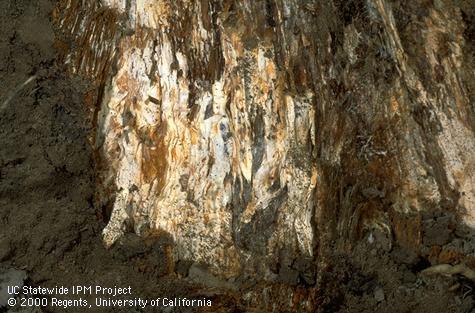
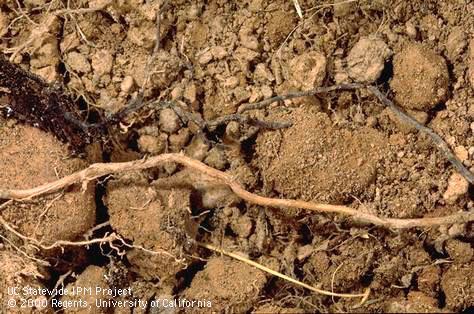
Cane dieback and wilting are common symptoms of Armillaria root rot. The main roots and crown often have whitish- to cream-colored fan-shaped mycelia just under the bark. Branched black structures, resembling "shoestrings," grow through the soil from roots of infected plants to the healthy roots of neighboring plants. Armillaria sometimes produces mushrooms around the base of infected plants in fall.
Solutions
The potential for infection by Armillaria can be reduced by the removal and destruction of infected roots or stumps from the soil. It is very difficult to remove all infected wood and roots from the soil, but the progression of the disease can be slowed by this method.
For more information, see the Pest Notes: Armillaria Root Rot.