|
Convergent lady beetle (larva) Identification tip: Larvae are elongate with long legs and resemble tiny alligators. |
Convergent lady beetle (adult) Identification tip: Adults are mostly orange with black spots and converging white marks on the thorax. Some individuals have fewer spots, and some, no spots. |
|
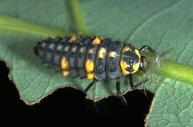
Sevenspotted lady beetle (larva) Identification tip: Larvae are elongate, grayish, yellow- spotted, and alligator shaped. |
Sevenspotted lady beetle (adult) Identification tip: Adults have a black thorax with white along the front margin. Seven black spots are on the red or orangish wing covers, which may have 2 white areas near the front. |
|
Parasitic wasp Identification tip: Parasitic wasps such as this Aphidius sp. lay their eggs in aphids. |
Parasitic wasp (aphid mummy) Identification tip: The cuticle of aphids killed by parasitic wasps turn bronze (or black) and crusty and are called mummies. The exit hole is evidence that the parasitic wasp has emerged. |
|
Identification tip: Adults and nymphs are oval, somewhat flattened, about 1/4 of an inch long, with a wide head and prominent bulging eyes. |
Identification tip: Adults are slender insects that are mostly yellowish, gray, or dull brown, measuring about 2/5 of an inch long, and have elongated heads and long antennae. |
|
Identification tip: Adults are small, 1/12 to 1/5 of an inch long, oval, black or purplish with white markings, and have a triangular head. |
Identification tip: Larvae are legless, maggot shaped, and opaque with tapered heads. |
|
Fungal diseases Identification tip: Entomopthora fungi first turn aphids pink and brown, later causing them to shrivel up and die. |




Text Updated: 06/16